Material coverage cheat sheet
One sheet, one gallon, one bag, one cubic yard, one roll — here is how much each common renovation material actually covers, in one place, with the formula behind every number.
The short answer
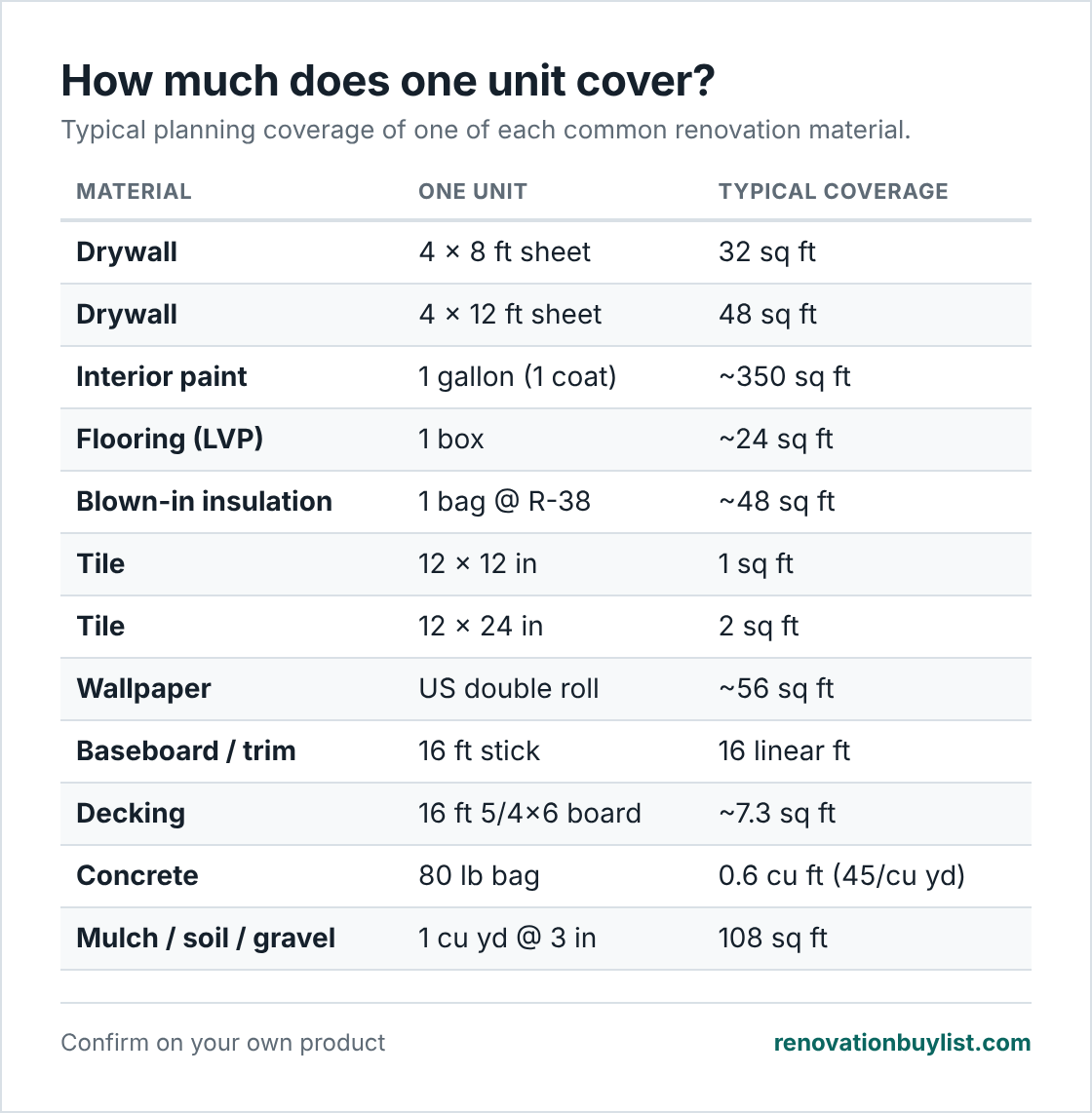
Every material estimate is the same move: take the area (or length, or volume) you need to cover, add a waste allowance, and divide by what one unit covers. The hard part is knowing that last number for each material. Here they all are in one place — the typical planning coverage of one of each common renovation material, the same figures our calculators use. Confirm the exact number on your own product before buying.
- 1 gallon of paint ≈ 350 sq ft per coat
- 1 sheet of 4 × 8 drywall = 32 sq ft (4 × 12 = 48 sq ft)
- 1 cubic yard of mulch / soil / gravel = 108 sq ft at 3 in deep (324 sq ft at 1 in)
- 45 × 80 lb bags of concrete = 1 cubic yard
- 1 US double roll of wallpaper ≈ 56 sq ft usable
- 100 × 12-inch tiles = 100 sq ft (1 sq ft each)
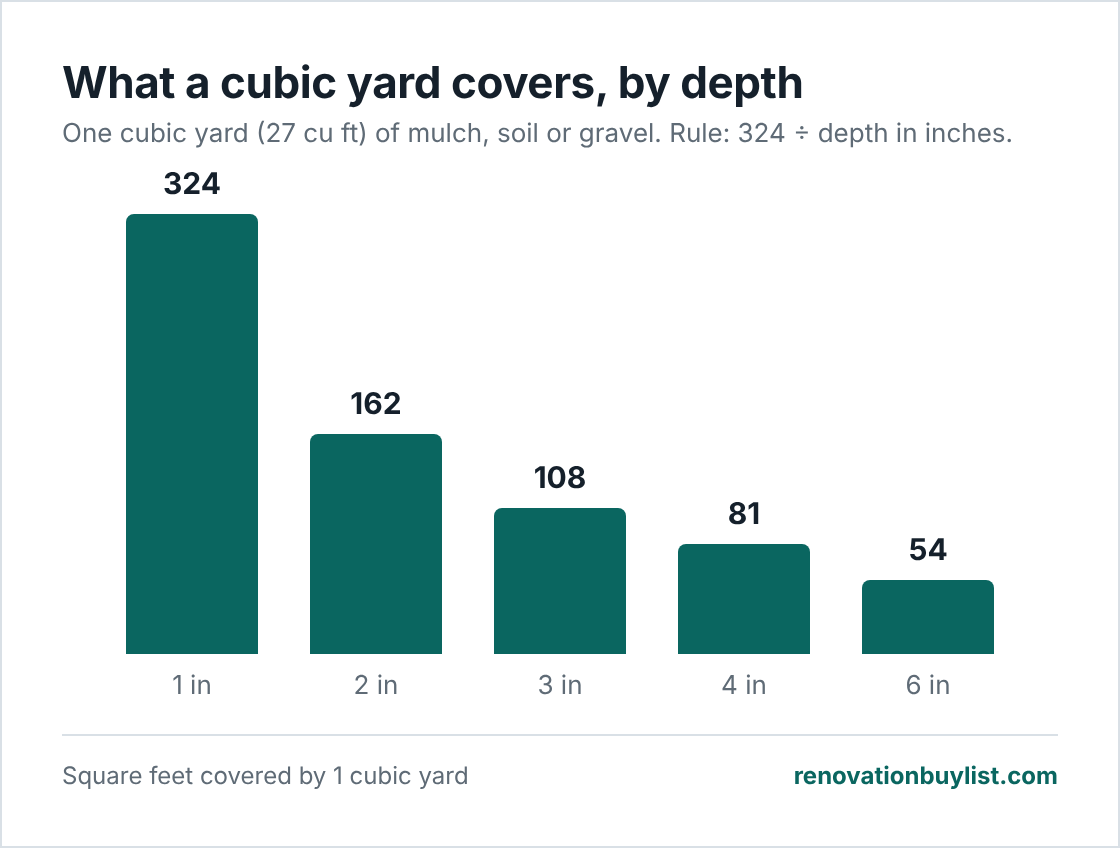
How much a cubic yard of mulch, soil or gravel covers, by depth
Bulk landscape material is sold by the cubic yard (27 cubic feet). Spread thinner, it covers more ground; spread deeper, less. The relationship is exact: coverage = 324 ÷ depth in inches.
Coverage of one unit, by material
| Material | One unit | Typical coverage |
|---|---|---|
| Drywall | 4 × 8 ft sheet | 32 sq ft |
| Drywall | 4 × 12 ft sheet | 48 sq ft |
| Interior paint | 1 gallon (1 coat) | ~350 sq ft |
| Flooring (LVP) | 1 box | ~23.8 sq ft |
| Blown-in insulation | 1 bag @ R-38 | ~48 sq ft |
| Tile | 12 × 12 in | 1 sq ft |
| Tile | 12 × 24 in | 2 sq ft |
| Wallpaper | US double roll | ~56 sq ft usable |
| Baseboard / trim | 1 × 16 ft stick | 16 linear ft |
| Decking | 1 × 16 ft 5/4×6 board | ~7.3 sq ft |
| Fence | 1 section (8 ft spacing) | 8 linear ft |
| Concrete | 80 lb bag | 0.6 cu ft (45/cu yd) |
| Mulch / soil / gravel | 1 cubic yard @ 3 in | 108 sq ft |
Typical planning values, not product guarantees. Coverage changes with surface, waste, gaps, pattern and the specific product — confirm the figure on your packaging. Formulas and sources: methodology.
Turn coverage into a quantity to buy
buy = area (or length/volume) × (1 + waste allowance) ÷ coverage per unit → round up
That one line is every calculator on the site. Pick the material and the tool does the rounding for you:
- Drywall · Paint · Flooring · Insulation
- Concrete · Tile · Mulch & soil · Baseboard
- Wallpaper · Decking · Fence · Whole-room planner
Why your real coverage is often a little less
Published coverage is a best case on an ideal surface. New or textured drywall drinks more paint; tile and flooring lose material to cuts and the pattern; bulk material settles; a dark-to-light paint change needs an extra coat. That is exactly why every quantity here is built on top of a waste allowance you can see and change — see why you buy more than you use.
Save or share these charts
Free to republish or embed on your own site with a link back to renovationbuylist.com.
See it applied to real rooms
Coverage per unit is half the answer; the other half is how much area a given room has. For worked quantities across twelve common room sizes — drywall, paint, flooring, baseboard and wallpaper side by side — see materials by room size, or run your exact room in the whole-room planner.
Questions
How much does a cubic yard cover?
One cubic yard (27 cubic feet) of mulch, soil, gravel or sand covers about 324 sq ft at 1 inch deep, 162 sq ft at 2 inches, 108 sq ft at 3 inches, 81 sq ft at 4 inches, and 54 sq ft at 6 inches. Deeper layers cover proportionally less — the rule is 324 ÷ depth-in-inches.
How much does a sheet of drywall cover?
A standard 4 × 8 ft sheet covers 32 sq ft; a 4 × 12 ft sheet covers 48 sq ft. Divide your net wall-and-ceiling area (with a waste allowance) by the sheet size and round up.
How much does a gallon of paint cover?
About 350 sq ft in one coat on a smooth, primed, similar-coloured wall — plan at 350, not the 400 some labels claim, because new drywall, texture and colour changes all cover less.
How many bags of concrete make a cubic yard?
About 45 of the common 80 lb bags (each yields ~0.6 cu ft; 27 ÷ 0.6 = 45). Over roughly a cubic yard, ready-mix delivered by the yard is usually cheaper than bags.
Are these coverage figures exact?
They are typical planning values — the same ones our calculators use — not product guarantees. Coverage changes with surface, waste, gaps, pattern and the specific product, so always confirm the figure on your own packaging. Every formula is on our methodology page.